For the Greek Forum of Refugees, integration is not only about learning the language of the host country or accessing services. It is about belonging, participation and having a real voice in the community where you live.
This perspective is at the centre of GFR’s contribution to SCHOOLinHUB, an EU-funded AMIF project supporting the integration and language learning of young children with migrant backgrounds and their families.
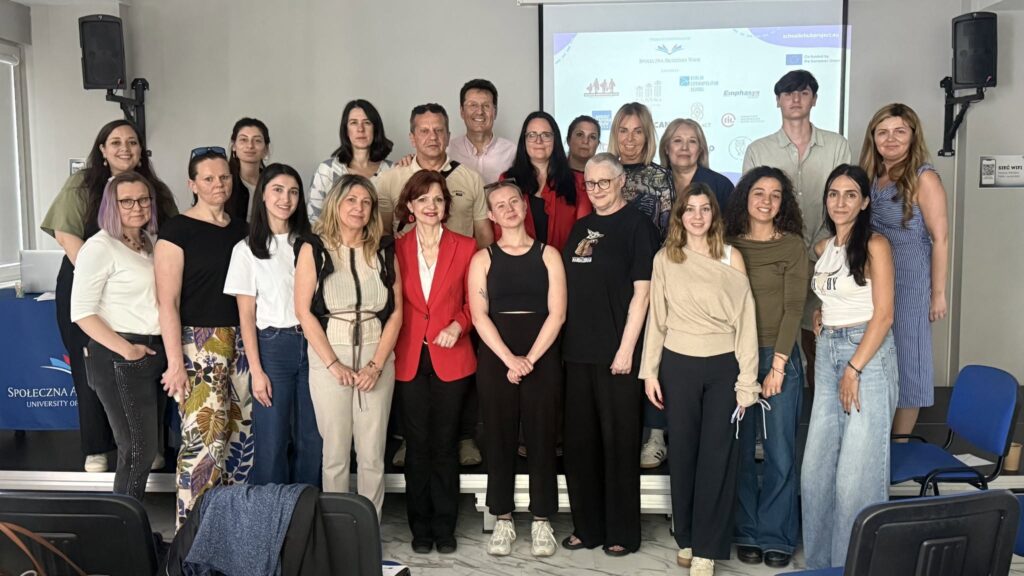
The project brings together 13 organisations from across Europe and works with schools, educators, parents, migrant communities, municipalities and other local actors. Its overall ambition is to help schools become welcoming hubs that connect education with families and the wider community.
GFR participates in the project as the Greek Forum of Refugees and is one of the partners with a particularly strong role on the community dimension of integration. In the original project design, GFR is identified among the partners whose experience is especially connected to community-level work and supports the leadership of Work Package 4, the “First Aid Pack for Integration, Civic Orientation and Literacy of Migrant Parents.”
Bringing lived experience into the design
One of GFR’s main contributions to SCHOOLinHUB is a principle that has guided our work for many years: people with refugee and migrant backgrounds should not be treated only as beneficiaries of integration programmes. They should participate in designing them, taking decisions and implementing them.
This approach is reflected strongly in the Comprehensive Community Guidelines & Policy Recommendations, developed by GFR under Work Package 4. The Guidelines place people with lived migration experience at the centre as co-designers, co-decision-makers and co-facilitators, while recognising their experience as a form of expertise.
The Guidelines therefore propose the creation of Community Advisory Groups in which people with lived migration experience have a substantial role, alongside schools, municipalities, NGOs and other community actors. They also emphasise fair recognition of their contribution and, where possible, compensation for the time and knowledge they bring.
For GFR, this is important because meaningful participation cannot be an additional activity at the end of a project. It needs to be built into the way integration initiatives are designed from the beginning.
Integration does not stop at the school gate

Schools can be one of the first institutions through which migrant and refugee families build a relationship with their new community. But a school cannot create inclusion alone.
The approach developed through SCHOOLinHUB therefore connects schools with families, municipalities, refugee- and migrant-led organisations, NGOs, libraries, youth groups, sports associations, cultural organisations, volunteers and local services. The Guidelines describe integration as a shared responsibility in which different actors contribute different forms of knowledge and support.
Refugee- and migrant-led organisations have a particular role. They can reach people who may otherwise remain outside formal structures, build trust, contribute cultural and community knowledge, bring lived experience into programme design and identify emerging needs that institutions may not immediately see.
This is the role that GFR has sought to strengthen through SCHOOLinHUB: building bridges between communities and institutions rather than expecting communities simply to adapt to existing structures.
Making participation possible in practice
Another important element of GFR’s perspective is that participation cannot be meaningful if people face practical barriers to taking part.
The Community Guidelines therefore treat interpretation, childcare, transport and accessible venues not as optional extras, but as basic conditions for participation. They also call for clear information, accessible communication, safe spaces and activities organised at times that work for families.
The document translates these principles into practical models that communities can adapt, including:
-
- an eight-week Parent Language & Everyday Life course connecting language learning with real situations such as communicating with schools, using public transport, visiting services and participating in civic life,
-
- MyBuddy Parent, pairing newcomer parents with more established migrant or local parents for practical peer support,
-
- safe spaces for women and girls,
-
- sports and cultural activities that combine language learning with participation and social connections,
-
- Community Advisory Groups through which families and community members can influence decisions,
-
- practical tools for safeguarding, accessibility, volunteering and monitoring.
These are designed to move integration away from abstract concepts and towards situations people experience every day.
Building on GFR’s community experience
The Guidelines also draw directly on approaches developed through GFR’s own work over many years.
Experience from HARTS contributed methods for safe spaces, outreach to women and families, trust-building and co-designed activities.
The Self-Advocacy Team contributed GFR’s experience of lived-experience leadership, co-design and participation in decision-making.
ERMES contributed practical knowledge related to interpreters, codes of conduct, cultural and gender sensitivity, privacy, safeguarding and trauma-aware approaches.
Bringing these experiences into a European project is important for GFR. It allows practices developed together with refugee and migrant communities in Greece to contribute to tools that can be adapted by schools and communities in other European countries.
At the same time, GFR benefits from the experience of the other SCHOOLinHUB partners and from the opportunity to test ideas in different educational and community contexts.
From participation to local policy
The work is not limited to activities.
The Community Guidelines also include policy recommendations for municipalities and local authorities. Among them are:
-
- stronger recognition and funding of refugee- and migrant-led organisations as equal partners,
-
- institutionalising community advisory structures,
-
- providing interpretation, childcare and transport as standard inclusion measures,
-
- connecting schools more systematically with civil society and local communities.
For GFR, this policy dimension is essential. Good individual projects can create important opportunities, but lasting inclusion requires institutions to change the way they engage with refugee and migrant communities.
Schools as hubs of belonging
SCHOOLinHUB gives GFR an opportunity to bring one of our long-standing messages into the field of early education: Integration is a two-way and community-wide process.
A welcoming school matters enormously. But real belonging develops when the child, the parents, the school and the wider community are connected.
Our contribution to SCHOOLinHUB therefore seeks to ensure that refugee and migrant families are not viewed simply as people who need to learn how to fit into a new environment. They bring experience, skills, cultures, ideas and knowledge of their own
When this contribution is recognised and when people are given meaningful opportunities to participate, schools can become much more than educational institutions. They can become genuine hubs of inclusion, participation and belonging.
Learn more about the SCHOOLinHUB project: https://schoolinhubproject.eu/
The SCHOOLinHUB project is co-funded by the European Union under the Asylum, Migration and Integration Fund (AMIF), Project No. 101141033